
Integrating agrivoltaics practices in fruit orchards: a multidisciplinary study on soil carbon turnover, greenhouse gas fluxes and climate change mitigation potential (FruitPower)
Dāniels Udalovs, Monta Krista Jansone.
Contact person at the Institute of Horticulture (LatHort): Edgars Rubauskis
Project Leading Partner: Latvian State Forest Research Institute “Silava”
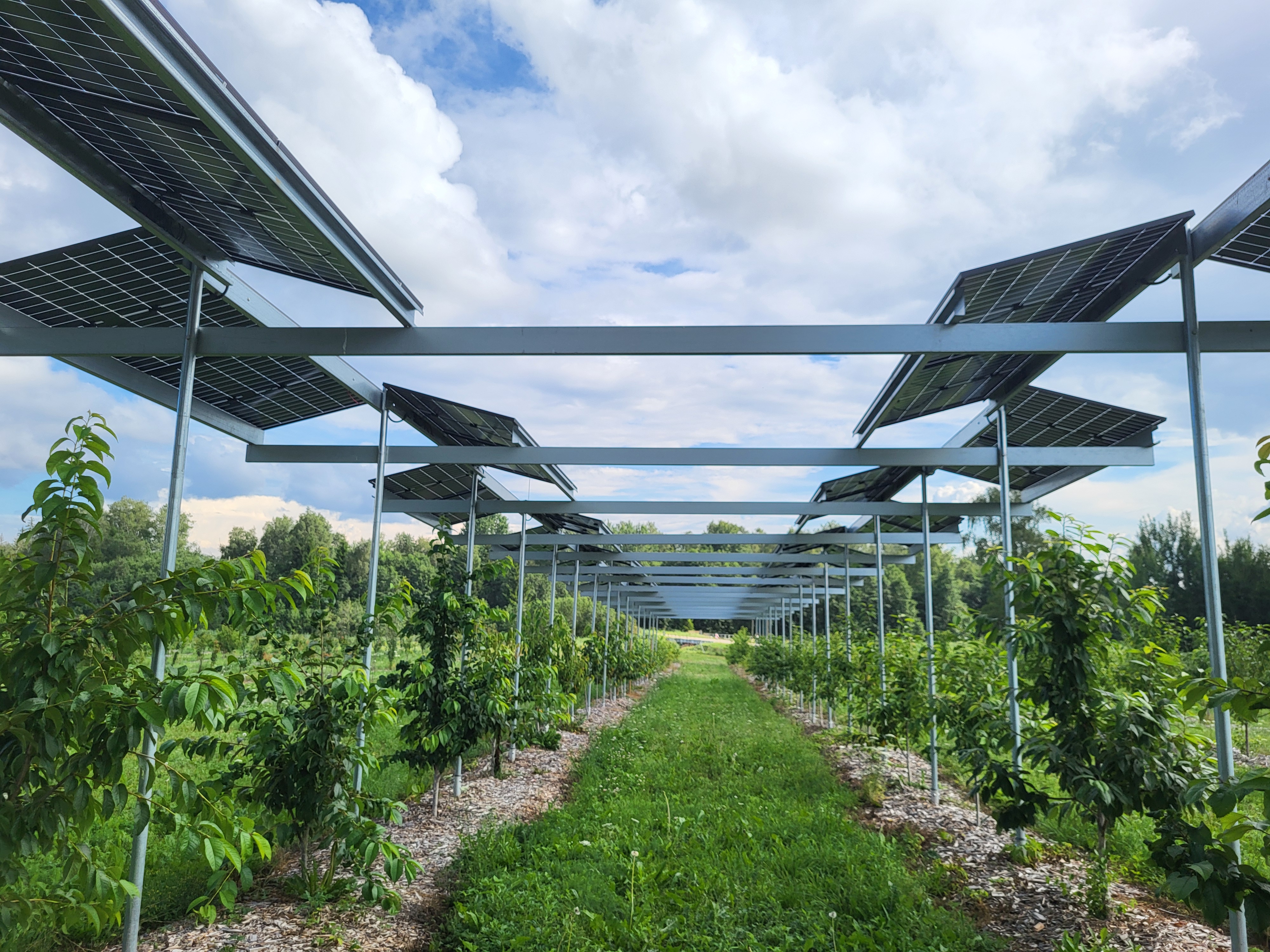
The project aims to assess the climate change mitigation potential of integrating agrivoltaic systems into fruit orchards. It addresses the need to reduce greenhouse gas (GHG) emissions and enhance carbon sequestration in perennial cropping systems by combining fruit production with on-site renewable energy generation. The project will analyse the environmental and socio-economic impacts of installing solar panels in orchards (cherries, and imitating the partial shading on berries and grapes as well as other perennials) and assess their effects on soil carbon turnover, GHG fluxes, and fruit yield and quality. The study focuses on apple and cherry orchards in Latvia and includes both field experiments and modelling. By combining expertise in horticulture and environmental science, the project will develop improved methods for estimating GHG emissions in orchards, evaluate electrification scenarios for orchard operations, and propose policy recommendations for scaling up agrivoltaic practices.
The scientific objectives aligned with these questions are:
- To quantify carbon sequestration and net GHG emissions in traditional and agrivoltaic fruit orchard systems using Tier 1 and refined methodologies.
- To evaluate the energy balance of orchards integrating photovoltaic infrastructure and assess its optimisation potential for local electricity use and storage.
- To model the socio-economic implications of agrivoltaics, including investment needs, profitability, and mitigation cost-efficiency.
- To develop scientifically grounded recommendations for incorporating agrivoltaic practices into Latvia’s climate policy and NECP.
Key research questions:
- How does the integration of agrivoltaic systems influence carbon turnover and GHG emissions in fruit orchards?
- What is the effect of solar panel-induced microclimatic changes on soil parameters, crop productivity, and biomass dynamics?
- To what extent can on-site solar energy production offset fossil fuel-based energy use in orchard management and processing operations?
- What are the economic trade-offs and benefits of adopting agrivoltaic systems in fruit-growing enterprises?
- How can the results support policy instruments such as the National Energy and Climate Plan (NECP) and voluntary carbon markets?
Project activities:
- WP1 Scientific review of the impact of agrivoltaic systems in orchards on soil carbon turnover and GHG emissions from soil;
- WP2 Climate change mitigation effect of agrivoltaic systems in fruit orchards in land use, land-use change and forestry (LULUCF) and energy sector;
- WP3 Evaluation of GHG mitigation potential of energy efficiency and local energy use related measures in orchards;
- WP4 Cross-sectoral socio-economic assessment of agrivoltaic systems in fruit orchards;
- WP5 Revealing of the orchards' potential contribution to climate change mitigation;
- WP6 Scientific reporting and publishing;
- WP7 Project management and administration.