FruitPower Project: First Season
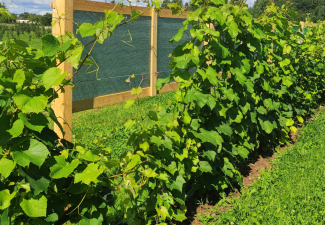
In 2026, as part of the project “Integrating Agrivoltaic Solutions in Orchards: An Interdisciplinary Study of Soil Carbon Cycling, Greenhouse Gas Fluxes and Climate Change Mitigation Potential (FruitPower),” vertical solar panel mock-ups were installed in the Institute of Horticulture’s orchards for grapes in Pūre and blackcurrants in Dobele. This will make it possible to assess how partial shading affects growth, plant development, yield, and berry quality. For grapes, the structures provide several levels of light transmission.
The solar panels above the sweet cherries in Pūre affect plant growth and development, as well as greenhouse gas (GHG) emissions, while generating electricity. To assess these effects, we measured orchard emissions; collected grass biomass samples when mown; and recorded fallen branches and the biomass of pruned branches during tree canopy training. We also measured temperatures between the tree rows. For comparison, we took all measurements monthly in two treatments: with and without solar panels. A camera installed in the cherry orchard records how the shade moves throughout the day. This is expected to help clarify the overall cycling within the orchard ecosystem. As is known, plants store carbon temporarily in fruit and leaves, and over the longer term in wood.
In 2026, the solar panels generated 27.3 MWh of electricity across 255 m² of the cherry orchard, with the panels covering 96 m². The panels generated the most energy in May (4.25 MWh) and June (4.7 MWh). By comparison, generation was 2.52 MWh in March, 3.7 MWh in April, and 3.87 MWh in July.
In Dobele, carbon-sequestration observations were expanded to include data on the yield and growth of early sweet cherries under different light conditions: beneath VOEN cover, which blocks around 20% of the light, and without VOEN cover, with 40% shade netting placed directly over the trees. The netting also protected the crop from birds. The sides of the orchard section covered with VOEN were also enclosed with shade netting to reduce bird activity.
In this first year of the project, the blackcurrant crop had already developed before the solar panel structures were installed. However, during the second half of the growing season, the leaf chlorophyll index was measured on shaded and unshaded bushes of the cultivars ‘Ritmo’, ‘Karina’ and ‘Domino’.
As in the cherry orchard, work in the apple orchard aimed to capture changes in the carbon cycle. Project partners from the Latvian State Forest Research Institute “Silava” measured gases at the established monitoring points. Grass samples collected before mowing were analysed, along with samples of branches pruned during summer training, thinned fruitlets and the harvest. More detailed studies have also begun to assess the diversity and occurrence of herbaceous plants in the apple orchard, taking into account the sown grass mixtures. The overall situation at the Institute of Horticulture site in Dobele had been documented earlier; see [here].
Measurements of plant growth will be taken as preparations for the next season continue. The accumulated data will be assessed to build a clearer picture of what is happening in the orchard and to plan future observations.
For more on the work and plans behind the launch of the agrivoltaics (hortivoltaics) project in LV, see [here].